Saturday, April 5, 2014

Afghanistan and Hotel Rouge

I was in Washington, DC for a computational social science conference, SBP2014, and stayed at the Hotel Rouge, which features numerous Venus statues (Veni?), cheetah and zebra robes, and a very cool restaurant, the “Bar Rouge.” I spent the week having friends and colleagues over for dinner at “The Rouge,” which is only two doors down from the Kazakhstan embassy, and generally having a great time on Embassy Row.
On Thursday night, I invited Frank Ritter of Penn State over, who I had only talked to a few times while he was on sabbatical, but we had never really had the chance to hang out and talk. On a wonderful spring evening, we settled into Bar Rouge, ordered some Stella Artois Cidre, which in my opinion is surprisingly good, and started chatting. Frank had given a great talk on the use of computerized moving targets for shooting instruction, so we talked about that for a while, and then he asked me about Afghanistan.
Two years ago I had gone to Kabul to work as a quantitative counterinsurgency (COIN) analyst for the US Special Operations Command (SOCOM) based on some work I did for DARPA, which some people find sort interesting. Professionally, I’m a recovering academic because after having published my political economy thesis with a semi-reputable press, I couldn’t get a job as a professor. In the late 1990s, applying computational techniques to political problems was viewed skeptically, though now they have conferences on it. In 2011 though, SOCOM thought I could help blend politics and economics with security within a single analytic framework as required by COIN theory. After having earned two degrees in international relations, which primarily concerns the study of war, the idea of actually going to a warzone and applying what I had learned and hopefully making a difference to the war effort was exciting. People asked how I could go, but I wondered how I could not go. I have always been interested in the special operations community, so the opportunity to observe it up close was one to be taken seriously. I left for Afghanistan in August 2011 and returned in March 2012.
Fueled by Stella Cidre, I told Frank about my adventures in Afghanistan. I had become reluctant to talk about my time there not because of any trauma that occurred but because when I got back I had to perform immediately on a DARPA program and most people don’t really want to hear about what happened because it’s just so foreign and remote from their day-to-day interests and experiences. Frank though was very polite, listened, seemed genuinely interested, and he even asked questions from time to time. His encouragement and a few Cidres were all I need to tell stories for hours.  When I was done – or more accurately, when they closed the bar – Frank suggested that I write these stories down. I remember a cartoon from the ‘70s showing a self-involved and pretentious guy deep in thought with the caption, “After sailing across the Atlantic, Bill decides not to write about it,” and that’s the way I felt about my time Afghanistan. That is, everybody who comes back from war has a story, and after having read many of them, I’m not sure the world needed mine. But Frank’s enthusiasm was infectious, and he convinced me to write some of them down, at least enough to see if there’s some “there” there. 

Sunday, March 2, 2014

Rhetoric and reality -- a systems example

It is surprising – at least I find it surprising – that the idea there is an underlying complex structure underlying social systems is not more widely acknowledged and accepted. This is especially true as this complex social system goes by another name, “reality.” I claim that this reality is composed of a number of systemic tensions that give rise to our ongoing political debates, so it would be reasonable to ask that at least one tension be articulated. While there are many from which to choose – positive and normative, innocence and experience, affect and cognition, elitism and democracy – I’m going to start with rhetoric and reality because it reveals the others. In political science school, the role communication is ignored, or at least was ignored while I was there, but increasingly it seems to play a determinative role in politics. Marshall McLuhan said, “the medium is the message,” and while true, the dictum is too abstract and compressed. The Rhetorical President by Jeffrey K. Tulis helps to explain and make clear the changes in the American polity that have led to our present state. That is, in the 20th century there has been an increased reliance on information gained over an increasingly potent media rather than actual experience, and this has numerous political consequences.
I first thought about this while reading On Democracy: Toward a transformation of American society by Joshua Cohen and Joel Rogers (1983), which is part of the “third-way” saving socialism literature. Cohen and Rogers argue that instead of all economic decisions being made by a central government committee, which didn’t work, then all decisions should be made by voting. Interestingly, this book was reviewed favorably by Frances Fox Piven of Cloward-Piven Strategy fame. The obvious problem with Cohen and Rogers’ argument is that if central-committee socialism failed because of distorted information channels, wouldn’t democracy-based decisions be subject to similar problematic information distortion? Part of this insight came from my experience in California elections in which tens of different ballot initiatives were put forth on a range of important topics. I know I didn’t know enough to make an informed decision, and I was probably more informed than most of my fellow voters, which made California’s extreme democracy inherently problematic. As a side not, Joshua Cohen’s response to this argument was to become incandescently angry, which was first experience “arguing” with progressives.
The point though is that communicating with a mass audience through a technical information channel – whether it be radio, TV, movies, or written media – rewards clarity and simplicity. The problem is that reality is complex, which argues against clarity. This makes the ascendency of the rhetorical presidency especially problematic because as we increasingly select our leaders based on their speaking capability, this will come at the expense of the experience that underlies an appreciation of our American complex social system that is necessary for effective policy. We need only look to the Affordable Care Act (i.e., “Obamacare”) to see the problems associated with selecting leaders based on their ability to communicate clearly and convincingly rather than, say, having a deep and accurate understanding of the subjects about which they’re talking. This is an enduring political system tension with a history going back to Plato’s Gorgias. Today’s media gives weight to rhetorical rather than technical expertise, hence the ongoing litany of policy failures and search for scapegoats.
Just to give a center to the argument, I find it curious that MIT, supposedly a hotbed of logical thought – and it certainly is with regards to engineering, physics, and computer science – continue to spew forth extreme leftists like Noam Chomsky, Paul Krugman, and Joshua Cohen. In the context of this argument, these thinkers are problematic because they dispense policy advice based on their own perspective rather than what’s actually workable or at least likely to work. Obamacare is only the most recent example of policies that are sold rhetorically only to fail in the real world. And these problems are entirely predictable and due to an overreliance on rhetoric. Richard Feynman (MIT 1939) got at the crux of this issue when he said,
The game I play is a very interesting one. It’s imagination in a tight straightjacket, which is this: that it has to agree with the known laws of physics. I’m not going to assume that maybe the laws of physics have changed, then I can design something. But I try --  supposing it’s everything that we know is true – as we think it is. If we do…. if we’re wrong, of course then we can design something with the new laws later. But the game is to try and figure out, with what we know what’s possible. So it requires imagination to think of what’s possible.  Then it requires an analysis back, a checking, to see whether it fits – it’s allowed with what is known.

So with regard to Cohen and Rogers’ On Democracy, it seems that they used imagination to articulate a new and camouflaged type of socialism but failed to perform the “analysis back” or the “checking” to see if it squares with what we know is possible. If centrally planned socialism fails do to information distortion, then it seems reasonable that democratically driven socialism by which decisions are made by voting rather than local expertise, is also problematic. This is the root cause of today’s political problems, and the evidence for media-based information distortion is accumulating steadily. Cohen’s response to this argument was basically the same as Herman Finer’s reaction to Friedrich von Hayek in Road to Reaction, which Hayek said was, "a specimen of abuse and invective which is probably unique in contemporary academic discussion." Of course, that was an earlier and gentler time, and such abuse and invective is becoming more frequent and regular from an increasingly beleaguered progressive movement. 

Saturday, March 1, 2014

Fundamental tensions

In thinking about politics and its characteristics and contours, I take a systems approach, which implies several things. First, social systems are complex systems. Second, social systems include physical systems that have enduring characteristics – that is, a nature that can’t be wished away or changed. Third, there are a host of general rules or system guidelines that have been created to provide insight into the formation of policy and the maintenance of governance of social systems, which should be understood and applied by those who implement policy, but that is most certainly not the case currently.
The motivation here is to improve policy understanding the character of the system being governed. Without such an understanding, policies are implemented by aspiration or popularity resulting in the advertising ethic, “the truth is that which sells” – what the founding fathers called demagoguery. The problem is, policy should be judged by its long-term results, which has been more correctly characterized by the phrase, “a tree is known by its fruits,” which has been proven by the test of time.
This observation that all politics involves complex social systems is not new, with multiple philosophical constructs alluding to its enduring character including teleology, Trinitarianism, and dialecticism (and from the East, yin-yang-ism). However, what makes these subjects worth revisiting are the modern computational tools that allow progress to be make on achieving a deeper and more grounded understanding of these topics. That is, while previous generations of thinkers could only describe such systems in prose, modern computers allow us to actually specify, quantify, and analyze such systems.
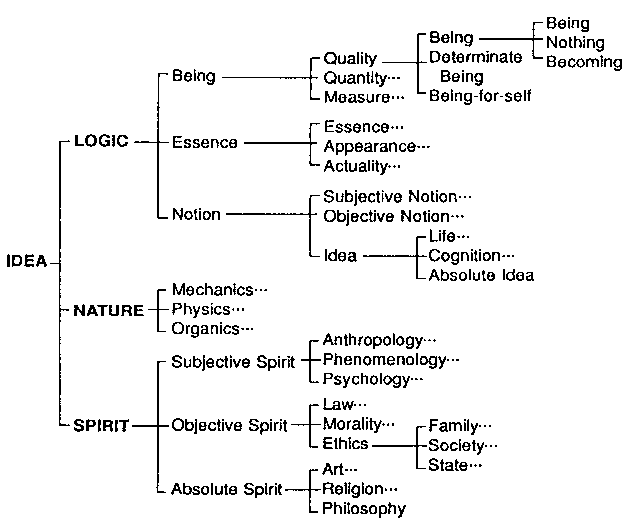
Concentrating on a single thinker, Hegel provided a systemic understanding of political systems and also introduced the notion of history in the sense of dynamic complexity and the difficulties associated with understanding and predicting system behavior over time. This interplay between system dynamics and structure (what has been called “macrodynamics from mictrostructure”) isn’t just a theoretical exercise – indeed, for these observations to have any worth they must have consequences in the real-world. And that’s the point of this post, just to say that many of today’s debates provide insight into the deeper, underlying, complex and obscured systematic structures. However, we know enough today to start to articulate and define these structures, and the benefit of doing so is that they will allow for more effective policy, which is important because, per the aforementioned system guidelines, “high morality depends on accurate prophecy.” Today’s demagogic policy, in contrast, employs unrealistically optimistic prevarications to get enacted and then provides inevitably disappointing results, the antithesis of morality.
 So how do these systemic aspects get revealed, and what difference do they make? My contention is that these fundamental systemic tensions get revealed through enduring political debates. The debates we have, and their enduring nature reveals the contours of the underlying system if we’re sensitive to them and understand their nature – what might be characterized as complex conservatism. My next several posts will attempt to reveal some of these fundamental systemic tensions. 

Sunday, February 16, 2014

Complex Conservatism: The math behind "The Great Relearning"

There are a couple of things that I take for granted, assuming that everybody knows, but that may not be the case. For example, conservatism in my mind consists of a set of truths or rules or lessons that have guided society and that every generation should learn. I almost wrote "must" learn but the need not learn these rules, but if they don't, the trouble will almost certainly result. These rules used to go by the name of Western Civilization or Christianity. Now not all the rules are "true," but they are very good, and the rules are ignored or disobeyed at society's peril.

However, the academy is populated by innovators who make it their life's work to analyze, criticize, and disobey this received wisdom. However, this has been going on long enough that there is a record that can be evaluated, and the long-term viability of these innovations has been found wanting. Tom Wolfe wrote about this memorably in "The Great Relearning," (TGR) which looks at the unintended consequences of AIDS brought about through the sexual revolution. Now these unintended consequences are brought about by the complexity of the social system, especially when contrasted with the human mind - the key insight being that the complexity of the social system is much greater than the human mind can comprehend. However, if people concentrate on evaluating these consequences, then patterns can be discovered over time. These semi-unpredictable dynamics over time take on the character of evolution, containing certain elements of predictability and unpredictability. Viewed from this perspective, The Holy Bible contains the life lessons from previous generations being passed down from forefathers who love their children and don't want to see them get hurt. However, passing down tightly argued "proofs" tend not to be convincing or memorable to children, so these lessons have been passed down in the form of stories. What makes these stories valuable and worth preserving is their viability over time and their value in constructing viable societies. So rather than religion competing with evolution, religion actually depends on and explains evolution insofar as it articulates regularities and lessons.

With the advent of powerful computers, the contours of these complex social systems can begin to be articulated. Jay W. Forrester, in his "Counterintuitive Behavior of Social Systems," begins to articulate some of the lessons learned from evaluating the consequences of policy implementations. First, social systems are inherently insensitive to most policy changes that people choose in an effort to alter the behavior of systems. This indicates that changing social systems is much harder than it might first appear, which explains the failed social experiments described by Wolfe in TGR. Second, social systems seem to have a few sensitive influence points through which behavior can be changed. Moreover, the places where social systems can be influences tend to be non-intuitive, so ways in which society can actually be changed appear to be unimportant, and ways that appear to be obvious tend to be ineffective. Third, social systems exhibit a conflict between short-term and long-term consequences of a policy change. So policies that appear to be beneficial and effective in the short-term may in fact turn out to be costly and ineffective over the long-term. Conversely, policies that appear to be counterproductive and costly in the short-term may turn out to be beneficial and effective in the long-term. These observations can prove especially problematic in a democratic age in which emphasis is place on the intuitively convincing and short-term rather than the proven and long-term. This might help explain why failed policies continue to be repeated, precisely because they "seem" right.

Forrester developed a simulation methodology that captured what he meant by "complex," which is important because mostly such terms go undefined and unspecified. Forrester defined complex social systems as marked by nonlinear, stock-flow, and feedback causal relationships. Each of these are confusing to the human mind, and together they can be mystifying. Recently, network relationships should be added to this list. However, the policy consequences remain the same: these system features are ignored to a society's peril. And the ongoing record of failed social experiments indicates that people should be more circumspect of social innovation - that is, conservative. Wolfe ends his essay by saying that this process of realizing the value of and relearn these lessons will be known as The Great Relearning, "if anything so prosaic as remedial education can be called 'great'."

Saturday, February 8, 2014

Policy excellence 1

I today’s media saturated age, it’s difficult to know what “politics” really means anymore. Is it elections? Is it government institutions? Is it a TV debate? What politics should constitute is the study of rightly ordered personal relationships, but despite all the expended argument, emotion, and “rationality,” it seems that things are getting worse rather than better. Pick your measure—government debt, crime, mental health, graduation rates, environmental degradation, nuclear proliferation—the trend seems to be in the wrong direction. How could so much time, money, education, and energy be expended with such piddling results? This is the fundamental question behind this blog, what I call the policy problématique. That is, how can we move from what we have, policy failure to policy excellence.

But is the term “policy failure” too harsh? Is it, in today’s vernacular, unfair? If it evaluated in terms of pursuing actions with the plan of achieving intended and desirable results, then in too many instances it is all too accurate. Much of the reason has to do with they pay politics is pursued and scored. It is based on persuasion rather than accuracy; on the short rather than long-term; on emotion rather than logic; on simplicity rather than complexity. In other words, we no longer pursue ethics traditionally understood; we pursue the advertising ethic which holds that, “The truth is that which sells.”

The argument proceeds by recognizing that politics is complex. So far as the policy problématique is concerned, the difficulty of pursuing courses of action that achieve their intended effects is driven by the complex of system being influenced. Were the system simple, then the consequences could be easily predicted. However a complex, social system yields unintended consequences. Achieving policy excellence therefore requires addressing, acknowledging, and accounting for the complexity of social systems. The question is, how best to do this? The current answer is democracy, having people vote and the majority rules. We live in a democratic age, and this seems so normal, so right, so stable, and so reified that how could it be any other way? However, Tocqueville pointed out the costs of democracy and noted that in a democratic society, it is difficult to imagine anything else. Moreover, once the majority have pronounced their judgment on an issue, it is absolute. But democracy need not be reified because, as Herbert Simon points out, there are multiple ways to reach policy decisions. The most important thing, recognizing the complexity of social systems, is to find a way to address the complexity. Democracy is naturally flawed because the very notion of complexity is measured against the well-known limitation of human rationality. So fundamental is this limitation that Simon coined the term bounded rationality to describe it. The key problem with democracy is that it is fundamentally driven by a collection of limited human brains, and increasing their number can help but ultimately brains will not do what they cannot do. Also, in a media age, there is an argument to be made that increasing that democracy results in demonstrably worse policy outcomes.


So how can the complexity of social systems be addressed? Recognizing the cognitive limitations associated with bounded rationality, it is natural to seek a cognitive prosthetic—that is, a way to supplement and assist the brain, and one way to do that is through a computer. Three challenges and observations immediately present themselves. First, how does one actually execute computer-based policy, both the creation of the computer model and its implementation within an organization? Second, pushing some of the decision making responsibility to a computer works against the democratic ethic, which, because it has devolved in the advertising ethic, is actually beneficial from a policy excellence perspective. Third, recall that the genius of The Constitution was a stepping back in 1787 from the ineffective Articles of Confederation which had been in place since 1776. So perhaps, what is being recommended here, is correcting a political system that has been pushed out of balance by information technology—that is, today’s media—with the application of another technology, the computer-aided quantitative analysis. 

AFG 1

As the US military's effort winds down in Afghanistan and their elections approach - which are supposed to solve many problems but won't - now might be a good time to engage in some reflection on the engagement. The military have an acronym for this, as they do for most things - AAR or "after action review." First, let me state my opinion that the Afghanistan hasn't worked out that well, so there has to be a mismatch between expectations and outcomes, especially with regard to execution. Second, this is in no way a criticism of the people in uniform, though i may be critical to their leaders and policy makers.

Because I was feeling that Afghanistan was turning into a modern-day Vietnam, I revisited A Bright Shining Lie and found some criticisms by LTC Daniel Davis who complained loudly that the war in Afghanistan was failing. He made several arguments as to why including the corruption of the Afghans, the failure to report status and progress accurately, and wasted aid money. Even though LTC Davis traveled widely around Afghanistan, those who defended our efforts said that he had a distorted and limited view of the situation. We;;. sounds like these critics are defending, because for what analysis can't that be said? Davis to me said some pretty reasonable things because I had similar experiences there. There was this curious dynamic in which people in uniform would take me aside and vent about what was going on in the vague hope that I, as a civilian, could influence what was going on.

So I could indeed add my personal observations to the list of people coming back from Afghanistan, but those too could be semi-easily invalidated by a government official who has access to greater information and the news media. However, Davis offered a pretty insightful observation, that there has been no clear articulation of the long-term strategic objectives, and that matches with my experience. I heard one general say that going to Afghanistan was in America's national interest, but that struck me as wrong. Why do we need to go, and possibly die, in an impoverished, land-locked, and resource-less country on the other side of the world. To my way of thinking, that's the opposite of national interest. Of course we had to go there in 2001, but for such an extended time to the tune of $700 billion? I don't get it. And when I got there, another general told me that in ten years, when Afghanistan was a great, modern, and successful country, then we'd understand why we were away from our families. That struck me as almost Obama-esque levels of aspirational as opposed to realistic language.

In opposition to these aspirational or purportedly inspirational arguments, Davis asked three strategic questions: (1) What metrics characterize Afghanistan? (2) How should the change over time? and (3) How do US military missions contribute to these metrics? This seems to be baseline and fundamental level of analysis before committing thousands of Americans and hundreds of billions of dollars, but apparently that wasn't done, especially as aspirational and inspirational rhetoric is easier to generate, more convincing, and less rigorous.

So how does one go about creating a quantitative strategic analysis that stands up better under criticism and informs operations? First of all, you can check out the book Estimating Impact by Kott and Citrenbaum, but I'm going to try to apply that framework to Afghanistan over the next few months as a way to improve policy because, while I greatly admire the efforts and bravery of my colleagues in Afghanistan, I don't they were as effective as they might have been because they were not well led.

Thursday, January 2, 2014

Happy 2014

Was at a party jamming with Alan of Alan and the Aligators as 2014 arrived, which is definitely a good sign.